Your Entries Aren't the Problem: How to Practice Day Trading Futures Until the Small Loss Is a Reflex
Here's the part nobody putting a trading course in your feed will lead with: most people who try day trading lose money. Not because the markets are rigged, and not because they can't find a decent trade. They lose for a reason that's almost boring once you see it — and, better news, it's a reason you can practice your way out of before you ever risk a real dollar.
This isn't financial advice, and it's not a promise you'll make money. It's the honest version of how the small group of people who actually last get there. If you're looking for a secret indicator, this will disappoint you. If you want the real mechanic, keep reading — because it's the same mechanic behind getting good at anything under pressure. Reps.
Day trading is a skill, not a side of passive income
Day trading means opening and closing a position inside the same session — no overnight risk. People do it on stocks, options, forex, and futures. Futures on the Micro Nasdaq (MNQ), Micro S&P (MES) and Micro Gold (MGC) are popular with beginners because the contracts are small, the markets are deep, and the math is clean: each point is worth a fixed number of dollars, so you can define your risk before you click.
But make no mistake about what it is. It's not investing — investing is buying good assets and waiting years. Day trading is a performance skill, closer to a sport than a savings account. Your results come from thousands of small, fast decisions made under pressure. That framing is the whole game, because it tells you exactly how to get good: the same way you'd get good at any skill under pressure — by repeating it until it's automatic.
Where the money actually goes (it's not the entries)
If you sat down and audited a losing trader's account, you'd expect to find bad entries everywhere. You usually don't. Most beginners can find reasonable places to get in. The account dies somewhere else: the losers get too big. A trader takes a small, planned loss — then moves the stop "just this once," holds and hopes, and a $60 loss quietly becomes a $600 one. One or two of those erase a week of disciplined wins.
That's the leak. The edge is often real; the entries are often fine. The account bleeds out through an inability to take the small loss on schedule, every time, without negotiating.
The edge is usually real. The leak is almost always the same: you couldn't take the small loss on time.
This is genuinely good news, because it means the fix is a behavior, not a better strategy. You don't need a new signal. You need to be able to take a defined loss the instant price hits it — and behavior is exactly the kind of thing you can rehearse until it's a reflex, cheaply, without a live account on the line.
The habit that separates the ones who last: screen time first
Ask anyone who trades consistently how they got there and you'll hear a version of the same thing: they put in an enormous amount of screen time before they were profitable. They watched how price moves at their level, how their setup fails, and how it feels to take a loss and move on — hundreds of times. The catch for a beginner is that live screen time is expensive. Learning that lesson with real money can cost thousands before it sticks.
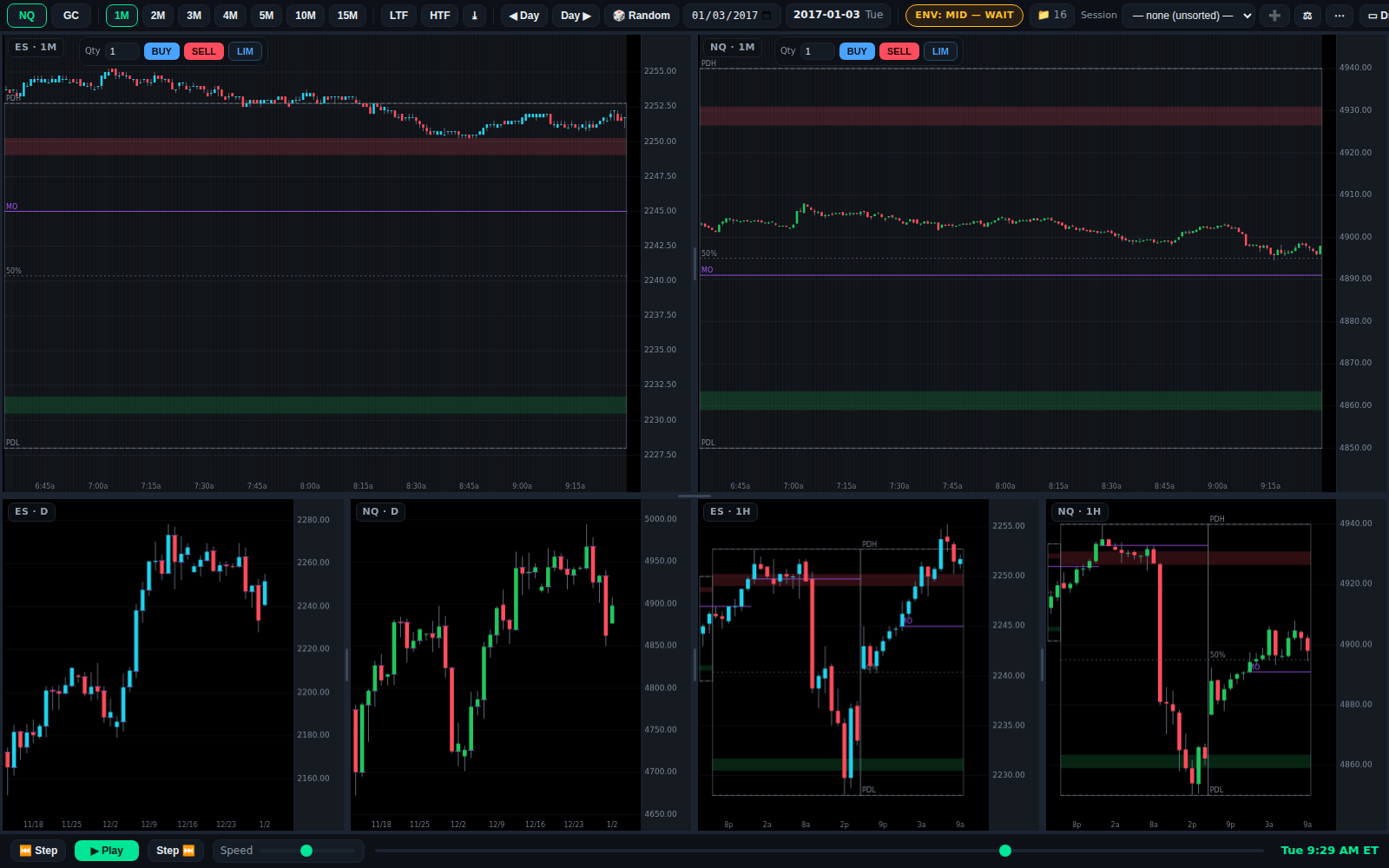
This is where market replay changes the arithmetic. Replay lets you load a real historical trading day and step through it bar by bar, placing simulated trades as if you were live. You compress months of screen time into a weekend. You take the small loss a hundred times in an afternoon until it stops feeling like a decision and starts feeling like a reflex — and you do it without funding the tuition out of your own account.
How to practice so it actually transfers
Random screen time doesn't build a skill — deliberate practice does. Four rules make replay reps count:
Trade one setup and only that. Write the exact conditions for your entry, your stop, and your target before you start. If a candle doesn't meet the rules, you don't take it. The goal isn't to trade a lot — it's to prove you can wait.
Set a fixed dollar stop and never move it. Decide the most you'll lose on a trade — say $60 on one micro — before you enter. The entire point of the rep is to practice taking that stop when price hits it. If you catch yourself moving it, congratulations: you just found the exact leak you came to fix.
Log every rep and review it. Each simulated trade is data — entry, exit, whether you followed your rule, what you saw. Patterns jump out fast when you can see fifty of your own trades side by side. This is also where an AI coach that reviews your logged reps beats any generic course: it can name the mistake you keep repeating, because it's grounded in what you actually did.
Then keep it small when you go live. When you do fund an account, trade the micros, risk a tiny fixed amount, and treat your first months as continued practice with real fills. The traders who last are the ones who stayed small long enough for the habit to hold under real pressure.
A realistic first 30 days
Week one: pick one instrument and one setup, and write the rules down. Week two: run replay reps — dozens a day — taking every planned stop on schedule and logging each one. Week three: review your log, find the trades where you broke your own rule, and rep those exact situations until the reflex holds. Week four: if — and only if — your logged reps show you can take the small loss consistently, consider a tiny live micro account and keep practicing with real fills.
Notice what's missing from that plan: any promise of a number. The goal for month one isn't profit. It's proof that you can follow your own rules. Get that, and you've done the hard part almost everyone skips.
Why this is the honest path
There's no shortage of people selling the fantasy — fund an account this week, pay your rent from it next week. That's not how any skill works, and it's certainly not how this one works. The honest path is less exciting and far more reliable: a boring, repeatable habit, built through reps, before your money is on the line. It's the same reason a pilot logs hours in a simulator before a full cockpit, and the same reason a fighter spars before the fight. You groove the reflex where mistakes are free.
You don't need to believe you'll get rich trading. You need to prove one thing to yourself first: that you can take the small loss, on time, a hundred times in a row. Do that where it's free, and you've earned the right to try it where it isn't.
Get the reps in before it costs you
Futures Rep Sim is a local market-replay trainer for Nasdaq, S&P and Gold. Load any real historical day, step through it bar by bar, place simulated trades, and let an AI coach grade the reps you logged — so you build the take-the-small-loss reflex before a live account ever costs you. You own the code and your data. One-time purchase, no subscription.
Get Futures Rep SimGet the good stuff first
Stay connected — I'll send you new resources, guides, and freebies as they drop. No spam, unsubscribe anytime.